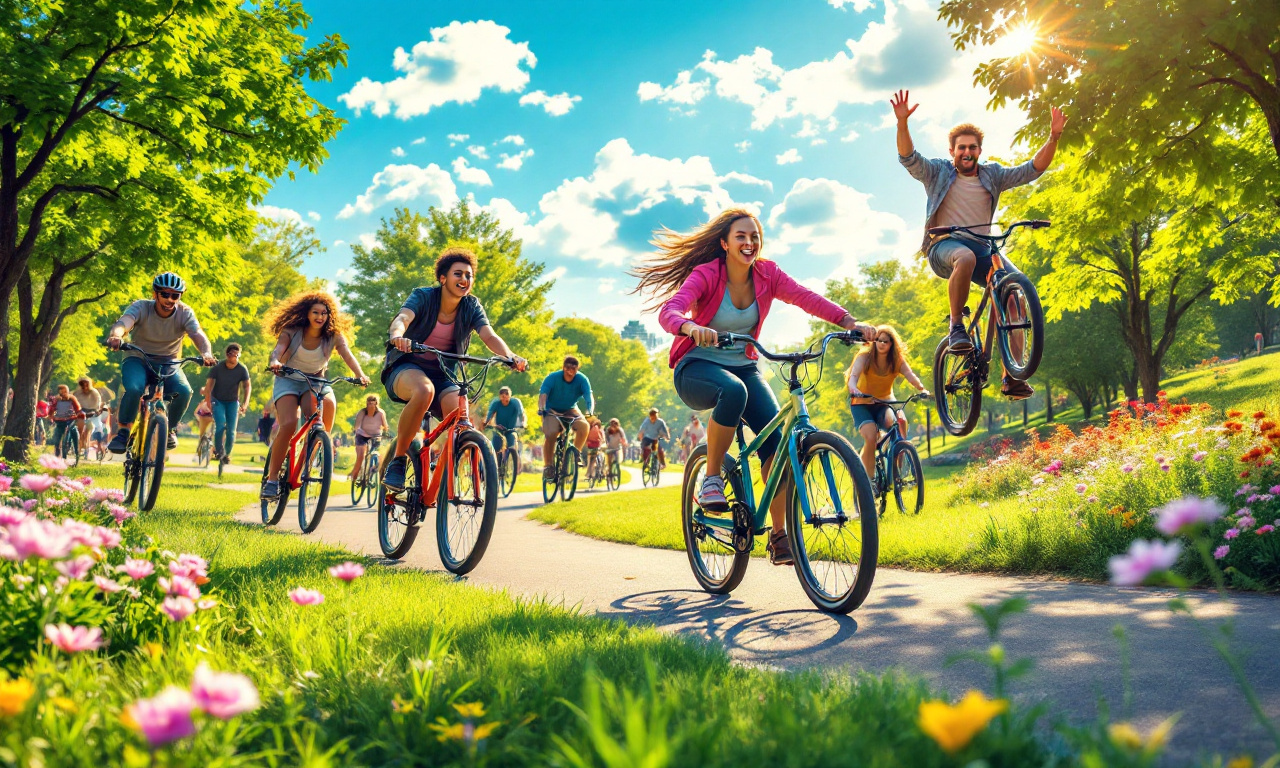

World Bicycle Day is celebrated annually on June 3 at the initiative of the United Nations. The holiday aims to promote the bicycle as an affordable, environmentally friendly, and safe mode of transportation, as well as to develop bicycle infrastructure in cities around the world.
The history of the holiday and the role of the United Nations
The resolution establishing World Bicycle Day was adopted by the United Nations General Assembly on April 12, 2018. The initiative was proposed by Turkmenistan, and 56 countries co-sponsored the resolution. The date of June 3 was chosen for the celebration, taking into account the climate conditions in most countries. In early June, the weather allows for mass bike rides and outdoor events.
The United Nations has recognized the bicycle as a mode of transportation that meets the goals of sustainable development: it reduces carbon emissions, improves air quality in cities, promotes public health, and provides affordable mobility. The resolution highlights the uniqueness of the bicycle as a means of transportation that has been used for over two centuries and remains relevant regardless of a country’s level of economic development.
“The bicycle is a symbol of sustainable transport, which carries a positive message about promoting consumption and production in a sustainable manner and has a positive impact on the climate,” reads the UN General Assembly resolution.
The holiday is intended to encourage Member States to include bicycles in transport and urban infrastructure development programs. The United Nations recommends that educational events, bike rides, and awareness-raising campaigns on the benefits of cycling be held on June 3.
What does World Bicycle Day mean for people and cities
The celebration of June 3 goes beyond a symbolic event. The holiday serves as an opportunity to discuss and implement specific changes in the urban environment. For cyclists, it is an opportunity to draw the attention of authorities to safety issues and the quality of infrastructure, while for cities, it is an opportunity to reconsider their transportation policies in favor of sustainable solutions.
World Bicycle Day helps to address the following challenges:
- The development of bike lanes and parking spaces in cities: the holiday encourages municipalities to allocate budgets for the creation and maintenance of bicycle infrastructure.
- Reducing car traffic: events on June 3 demonstrate that short-distance trips can be made by bicycle, reducing the burden on roads.
- Promoting an active lifestyle: Regular cycling reduces the risk of cardiovascular diseases, obesity, and diabetes.
- Raising awareness about the rights of cyclists: In many countries, drivers and pedestrians are not well-informed about the rules of interaction with cyclists on the roads.
- Social integration: Cycling remains an accessible mode of transportation for people with different income levels, which is important for developing regions.
More than 1 billion people worldwide regularly use cycling as a mode of transportation. The holiday highlights the significance of cycling for daily commuting, rather than just for sports or leisure activities.
How the holiday is celebrated in different countries around the world
The format of the celebration of June 3 depends on the level of development of the cycling culture in the country. In the Netherlands, Denmark and Germany, where the bicycle has long been integrated into the urban infrastructure, mass bike rides, conferences on sustainable mobility and festivals are held. In developing countries, the focus shifts to educational programs and drawing attention to the need to build bike lanes.
| Страна | Формат празднования | Особенности |
|---|---|---|
| Netherlands | Bike rides, retro bike exhibitions, and free repair shops | Participation of up to 500,000 people in major cities |
| Denmark | Conferences on cycling infrastructure, children’s cycling races | Copenhagen closes some of its roads for cyclists |
| India | Educational campaigns and the distribution of bicycles to schoolchildren in rural areas | Emphasis on transport accessibility for low-income families |
| USA | City bike rides, bike-to-work promotions, and discounts at bike shops | Large companies are participating, encouraging employees to commute by bike |
| Brazil | Street festivals, bike parades, and safety workshops | In São Paulo and Rio de Janeiro, highways are blocked for cyclists |
In many cities, on June 3, administrations temporarily expand bike lanes or close central streets to cars, allowing cyclists to move freely. In London, Paris, and Berlin, charity bike rides are held to raise funds for infrastructure development or support for cycling communities. In Asian countries like China and Vietnam, the holiday is used to remind people of the traditions of cycling, which have been partially lost with the rise of cars.
The History of Cycling: From Early Models to Modern Transportation
The first prototype of a bicycle appeared in 1817, thanks to the German inventor Karl von Drais. His “running machine” had no pedals – the rider pushed off the ground with his feet. In the 1860s, French craftsmen Pierre and Ernest Michaux added pedals to the front wheel, creating a “bone-shaker” bicycle with wooden wheels and a metal frame. By 1885, the Englishman John Kemp Starley introduced the Rover Safety Bicycle, the first bicycle with a chain drive, two wheels of equal size, and a modern-style frame. This design became the foundation for mass production. In 1888, the Scotsman John Dunlop patented pneumatic tires, making riding more comfortable and safer. In the 20th century, the bicycle evolved into specialized modes of transportation:
- Road models for cities with racks and chain guards
- Mountain bikes with reinforced frames and shock absorption for off-road riding
- Road bikes with lightweight designs for high-speed riding
- Cargo bikes with extended bases for transporting goods
- Electric bikes with assist motors for long-distance riding
Modern technologies have added carbon frames weighing less than 1 kg, hydraulic brakes, electronic gear shifting, and integration with navigation systems to the bicycle. The bicycle has evolved from an entertainment option for the wealthy to an affordable mode of transportation for billions of users worldwide.
Why is the bicycle relevant today?
The bicycle solves the practical problems of urban mobility without the need for fuel and parking. The average speed of movement in dense urban traffic is 15-20 km/h, which is comparable to that of a car, but without the need to wait in traffic jams. The bicycle can cover distances of up to 5-7 km faster than other modes of transportation due to its direct routes and the ability to bypass traffic congestion. The environmental aspect is expressed in specific numbers: one bicycle replaces 250 kg of CO2 emissions per year during daily commutes of 10 km. In cities with well-developed cycling infrastructure, such as Copenhagen, Amsterdam, and Utrecht, the share of bicycle commutes reaches 30-40% of the total traffic flow, reducing air pollution by 15-20%. The economic benefits are evident when comparing costs:
- Buying a bicycle: 30,000+ rubles vs. 1,500,000+ rubles for a car
- Maintenance: 2-3 thousand rubles per year vs. 50-100 thousand for a car
- No costs for fuel, insurance, parking, and vehicle tax
- The lifespan of a high-quality bicycle: 10-15 years with regular maintenance
Health improves with regular trips: 30 minutes of riding per day reduce the risk of cardiovascular diseases by 50%, help control weight and strengthen leg and back muscles. A bicycle provides an aerobic load without impact on the joints, unlike running. Infrastructure for cyclists is growing: in 2023, more than 300 km of new bike lanes appeared in Russian cities, bike rental systems are expanding, protected parking lots are being built. The development of electric bicycles makes two-wheeled transport accessible to people of different physical fitness levels and extends the range of trips to 30-50 km on a single charge.
World Bicycle Day in Russia: Traditions and Local Initiatives
World Bicycle Day on June 3 is celebrated in Russia with bicycle parades, mass rides, and educational events in major cities. Moscow traditionally hosts a bicycle parade through its central streets, attracting several thousand participants. St. Petersburg organizes nighttime bicycle rides through its historic center. Kazan, Yekaterinburg, and Novosibirsk organize family cycling festivals with workshops on bicycle repair and safety rules. Cycling organizations in Russia use the June 3 holiday to draw attention to the development of cycling infrastructure. Activists hold meetings with city authorities, publish studies on the state of cycling paths and parking lots, and launch petitions for expanding the cycling network. In some regions, new sections of cycling paths or bike rental stations are opened on this day.
- Moscow hosts a cycling parade along the Sadovoe Ring, with traffic closed to cars
- St. Petersburg — a night bike ride along the Neva River
- Kazan — a family bike festival in Gorky Park
- Yekaterinburg — a charity bike ride with the participation of local NGOs
- Novosibirsk — educational lectures about cycling culture in libraries
On the day of the holiday, municipal authorities in Russia provide free bicycle rentals, organize contests for the best bicycle design, and hold promotions for exchanging old bicycles for discounts at bicycle stores.
Interesting facts about cycling and the holiday
- The UN resolution on World Bicycle Day on June 3 was adopted in April 2018 with the support of 56 member states
- The holiday’s logo features cyclists of different ages and emphasizes the versatility of this mode of transportation for all segments of the population
- There are more than 1 billion bicycles in the world, which is more than the number of cars
- The Netherlands has the highest number of bicycles per capita, with 1.3 bicycles per person
- Copenhagen has 62% of its population that commutes to work by bicycle every day
- The first cycling marathon as part of the June 3 celebration was held in Tokyo in 2019, with the participation of 15,000 people
- The UN is calling on states to invest in cycling infrastructure as a way to achieve the climate goals of the Paris Agreement
- In 2022, the bicycle was included in the UNESCO Intangible Cultural Heritage List of Humanity at the initiative of Italy
- The average bicycle lasts 10-15 years with regular maintenance, while a car needs to be replaced every 8-12 years
- During the COVID-19 pandemic, global bicycle sales increased by 120% due to people’s desire to avoid public transportation.
Summary: Why World Bicycle Day Should Be Celebrated Every Year
World Bicycle Day on June 3rd reminds us of the practical benefits of bicycles for health, the environment, and urban mobility. The United Nations established this holiday to encourage countries to develop cycling infrastructure and promote active lifestyles among their populations. The holiday serves as an opportunity for dialogue between city authorities, cycling communities, and residents about road conditions, traffic safety, and the availability of bike rentals. The annual celebration on June 3 marks progress in the creation of bike lanes, legislative changes, and the growth of cycling populations. The United Nations recognizes cycling as a tool for achieving the Sustainable Development Goals, including reducing CO2 emissions, improving public health, and providing accessible transportation for all social groups. The celebration of World Bicycle Day amplifies these initiatives through mass events and awareness campaigns that reach millions of people worldwide.
